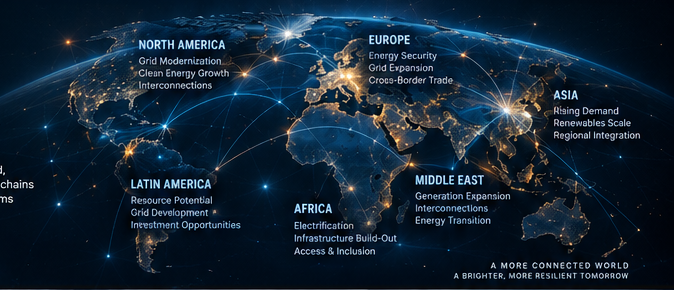
Electricity is taking a larger role in the global energy system. Global electricity demand grew by around 3% in 2025, compared with 1.3% growth in overall energy demand. Emerging market and developing economies accounted for around 80% of the increase.
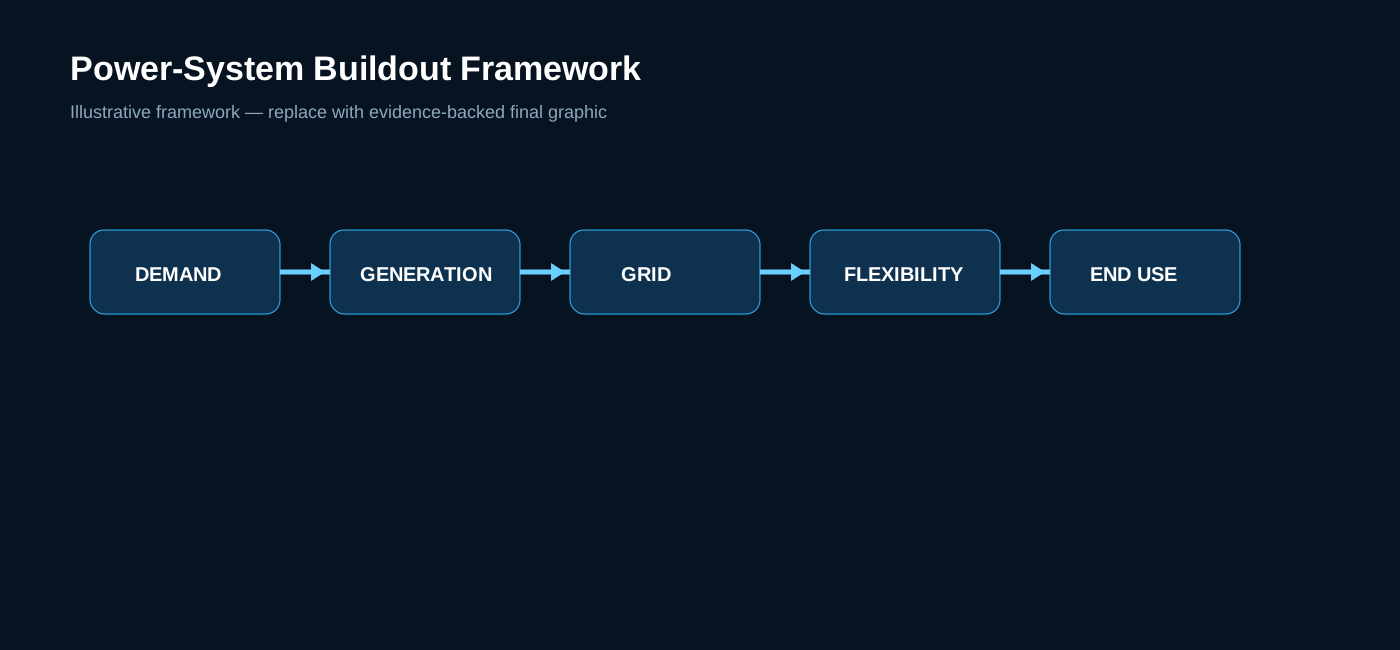
The significance of this shift is not simply that the world will consume more electricity. Electricity must be generated, transmitted, transformed, distributed, balanced and delivered at the time and location where it is required. Growth in electricity consumption therefore interacts with generation investment, network capacity, flexibility, equipment manufacturing, permitting, financing, market design and workforce capability.
Evidence-gated thesis: Electricity is becoming a larger and more strategically important part of the global energy system. Rising and changing electricity demand is driving substantial investment in generation, networks, flexibility and supporting infrastructure. However, the scale, technology mix and dominant constraints differ materially by region. There is no single global bottleneck and no universal power-system pathway.
Key Findings
Multiple end uses—not one technology—are behind global electricity-demand growth.
Renewables are expanding rapidly while coal, gas, nuclear and hydro retain different regional roles.
Queues, congestion, permitting and equipment lead times increasingly affect delivery, but grids are not the dominant bottleneck everywhere.
Batteries matter, but demand response, dispatchable generation, hydro, interconnection and network operation also provide flexibility.
The Structural Shift
For much of modern energy history, electricity was one component of an energy economy dominated by direct consumption of coal, oil and natural gas. That relationship is changing. Electrification is extending electricity further into transport, buildings and industrial processes, while economic development is increasing appliance ownership, cooling demand and industrial electricity consumption. Digital infrastructure and advanced manufacturing are also introducing large new loads in particular locations.
~3% — global electricity-demand growth in 2025, versus 1.3% growth in total global energy demand.
Electricity demand is becoming more structurally important across multiple sectors rather than being driven by a single technology.
The Age of Electricity is not primarily an AI story, an EV story or a renewable-energy story. It is the convergence of multiple structural changes across the electricity system.
Demand — More Electricity, but Not Everywhere at the Same Pace
Emerging economies remain responsible for most incremental electricity consumption. In 2025, emerging market and developing economies accounted for around 80% of global electricity-demand growth. At the same time, demand has returned to growth in advanced economies after a prolonged period of relative stagnation.
The drivers differ by geography. Economic development, industrialisation and cooling are especially important in India and Southeast Asia; cooling, desalination and industrial expansion matter in the Middle East; and data centres have become unusually significant in parts of North America.
Data centres: important, but keep the scale in perspective
IEA analysis projects global data-centre electricity consumption at around 945 TWh by 2030 in its base case—just under 3% of global electricity consumption. Their local impact can be much larger because large loads can be concentrated geographically and developed faster than major power infrastructure.
Data centres are globally significant, but locally they can be system-defining.
Generation — The Other Infrastructure Race
Rising electricity demand means generation matters at least as much as the network that transports its output. Global electricity generation increased by more than 850 TWh in 2025. Renewables supplied most of the increase, while renewable and nuclear generation together increased by more than total global generation growth.
Renewables reached roughly 34% of global electricity generation in 2025. Coal remained around 34% and natural gas around 21%. The transition is therefore substantial but incomplete, and regional generation portfolios remain very different.
Capacity is not generation
A gigawatt of solar, nuclear, hydro, wind or gas capacity does not produce the same quantity or profile of electricity. Actual generation depends on capacity factor, weather, fuel availability, maintenance, dispatch, curtailment, market conditions and network availability.
GW ≠ GWh ≠ TWh. Installed capacity and generated electricity must never be treated as interchangeable indicators.
The global generation race is becoming a race to build the right generation mix—not simply the largest number of gigawatts.
Grids — A Growing Constraint, Not the Universal Constraint
Generation cannot serve demand if electricity cannot reach consumers. More than 2,500 GW of renewable generation, storage and large-load projects are in connection queues worldwide. Grid investment has also lagged generation investment in many systems, contributing to congestion, connection delays and curtailment.
The timing mismatch is significant: major grid infrastructure can require many years for planning, permitting and construction, while some generation projects and large loads can be developed much faster.
But the evidence does not support the claim that the grid is the world's single bottleneck. Depending on the system, the binding constraint may instead be generation adequacy, fuel availability, financing, distribution infrastructure, permitting, equipment, workforce, market design or institutional capability.
There is no single global power-system bottleneck. There is a global race to remove different bottlenecks in different power systems.
The grid race is more than new transmission
The requirement includes transmission, distribution, substations, interconnection, digitalisation, grid-enhancing technologies and system operation. HVDC is strategically important for selected long-distance and interconnection applications, but it is not synonymous with the global grid transition.
Flexibility — Beyond the Battery Narrative
As variable renewable generation expands and demand becomes more dynamic, power systems need greater ability to respond across different timescales. Batteries are becoming a major short-duration resource, but flexibility is broader than storage.
Utility-scale battery additions reached about 63 GW in 2024, taking installed utility-scale capacity to roughly 124 GW. Batteries are particularly effective for fast response and short-duration energy shifting.
Flexibility can also come from demand response, hydropower, pumped storage, flexible thermal generation, interconnection, grid optimisation, industrial loads, managed EV charging and thermal storage.
The flexibility race is not simply a battery race. It is a race to make power systems capable of matching increasingly dynamic supply and demand across multiple timescales.
Regional Differences
A global transition does not produce a global template. The common direction is rising electricity-system importance; the dominant drivers and bottlenecks differ.
| Region | Dominant characteristics | Indicative system challenge |
|---|---|---|
| North America | Demand resurgence, data centres, manufacturing, renewables and gas | Connections, generation adequacy, transmission and local capacity |
| Europe | Moderate demand recovery, rapid renewable penetration | Networks, permitting, flexibility and market integration |
| China | Enormous demand and generation scale across multiple technologies | Integration, optimisation and efficient utilisation |
| India | Rapid structural demand growth with renewable and conventional expansion | Generation, transmission, distribution and flexibility |
| Middle East | Cooling, industry, desalination, solar and gas | Peak demand, generation and network expansion |
| Africa | Access, demand growth and insufficient infrastructure in many systems | Capital, generation, networks and institutional capacity |
| Latin America | Large hydro base plus expanding solar and wind | Transmission, hydrology and regional flexibility |
| Asia-Pacific | Highly heterogeneous; strong growth in several markets | Generation, fuels, grids, flexibility and interconnection |
Constraints — Building Capacity Is Not Enough
A project must move through planning, permitting, financing, engineering, procurement, manufacturing, construction, connection, commissioning and operation. Any stage can become the binding constraint.
Grid equipment lead times, nuclear construction performance and concentrated battery supply chains illustrate why the physical buildout is inseparable from the capability to deliver it. Capital, supply chains, workforce, permitting, regulation, markets, technology and geopolitics all sit around the physical system.
What could invalidate the argument?
Economic weakness, weather, prices or stronger efficiency could reduce the pace of growth.
Local generation and flexible demand can reduce some bulk-network requirements while increasing distribution complexity.
In some systems adequacy, fuel, financing or generation delivery can be the dominant constraint.
Nuclear, fossil flexibility, hydro, demand response and efficiency can materially change the required buildout.
Gate conclusion: the thesis is falsifiable, but current evidence does not falsify it.
Confidence in the Evidence
Structural demand growth; large-scale generation expansion; rapid renewable expansion; material grid constraints in many systems; rising flexibility need; fossil persistence; regional differentiation.
Exact 2030 demand trajectory; future technology shares; exact grid-investment requirements; future nuclear delivery; exact storage deployment.
Long-term AI electricity demand; commercial scale of new nuclear technologies; long-duration storage mix; future market-design responses.
What to Watch
Separate structural growth from weather, macroeconomics and forecast revisions.
Track actual generation as well as installed capacity.
Watch whether network delivery begins closing the gap with proposed generation and loads.
Manufacturing capacity may increasingly determine project schedules.
Conclusion
The evidence supports the arrival of a more electricity-intensive global energy system, but not a simple technology story. The Age of Electricity is not merely a transition from fossil fuels to renewables, a grid expansion programme, an AI-driven demand boom, or a future defined only by solar, wind and batteries.
It is a broader transformation in how economies produce, move, balance and consume electricity. Some regions need to expand generation and basic networks rapidly. Others need to restructure mature systems around variable generation and dynamic demand. Nuclear, fossil generation, hydropower, batteries, interconnection, demand response and efficiency will play different roles in different places.
The common denominator is the increasing strategic importance of the power system itself.
There is no single global power-system bottleneck. There is a global race to remove different bottlenecks in different power systems.
Understanding where those bottlenecks are—and what must be built to remove them—is the purpose of THE GLOBAL GRID RACE.
Methodology
Chapter 01 was developed through a structured evidence gate before final narrative drafting. Five evidence packs tested electricity demand, generation, grids, flexibility and the counter-thesis, followed by a regional sanity check across North America, Europe, China, India, the Middle East, Africa, Latin America and Asia-Pacific.
Source hierarchy
Primary and official data → international institutions → industry evidence → academic and independent research → media/commentary for context and leads.
Forecast treatment
Historical observations, forecasts and scenario requirements are kept distinct. Scenario labels and base years are retained where they materially affect interpretation.
Research controls
Capacity ≠ generation. GW ≠ GWh/TWh. Historical ≠ forecast. Forecast ≠ scenario requirement. Nominal USD ≠ real USD. Global averages are not treated as universal regional pathways.
Evidence labels
Evidence-backed for directly supported findings; evidence-backed / model-based for scenario or modelling work; Author Analysis for independent synthesis; and not supported / too broad for rejected claims.
Sources & References
Principal institutional sources used in Chapter 01. Accessed September 2026.
- International Energy Agency (IEA), Electricity 2026 ↗ — Demand, Supply, Grids and Flexibility.
- IEA, Global Energy Review 2026 ↗ — Electricity Demand and Electricity Supply.
- IEA, Electricity Mid-Year Update 2026 ↗.
- International Renewable Energy Agency (IRENA), Renewable Capacity Statistics 2026 ↗.
- IEA, Energy and AI ↗.
- IEA, Batteries and Secure Energy Transitions ↗.
- IEA, The Path to a New Era for Nuclear Energy ↗.
- IEA, Energy Efficiency 2025 ↗.
Recommended Citation

SATHISH KUMAR RAMARAJ
Project Manager | Power & Energy Infrastructure
M.Tech | PMP® | PMI-RMP® | MIET | ICGB™
Sathish Kumar Ramaraj is a power and energy infrastructure professional with experience across high-voltage substation and EPC project environments. THE GLOBAL GRID RACE is his independent research series on global power-system infrastructure.
About the Author →Chapter 02 — Generation Is Only the Beginning
Continue with the next published research chapter on generation adequacy, dependable capacity and electricity security.
Read Chapter 02 →